
Introduction to the Special Issue
“25 Years of the Euro: in the Era of Uncertainty”
DOI:
https://doi.org/10.47743/saeb-2025-0000Abstract
Marking a milestone of profound historical and economic importance, the 25th anniversary of the euro presents a pivotal opportunity to critically reassess the single currency’s performance and explore its prospects. Until the international financial crisis of 2008-2009, the introduction of the euro was widely regarded as a (somewhat surprising) success. This assessment quickly gave way to renewed questioning of euro membership as countries such as Greece, Ireland and Portugal requested financial assistance. The euro crisis is now largely a memory, although Greece’s real per capita GDP remains below its pre-crisis level. New challenges have emerged in recent years, from the economic and social consequences of the COVID-19 pandemic, to geopolitical instability and inflationary pressures.
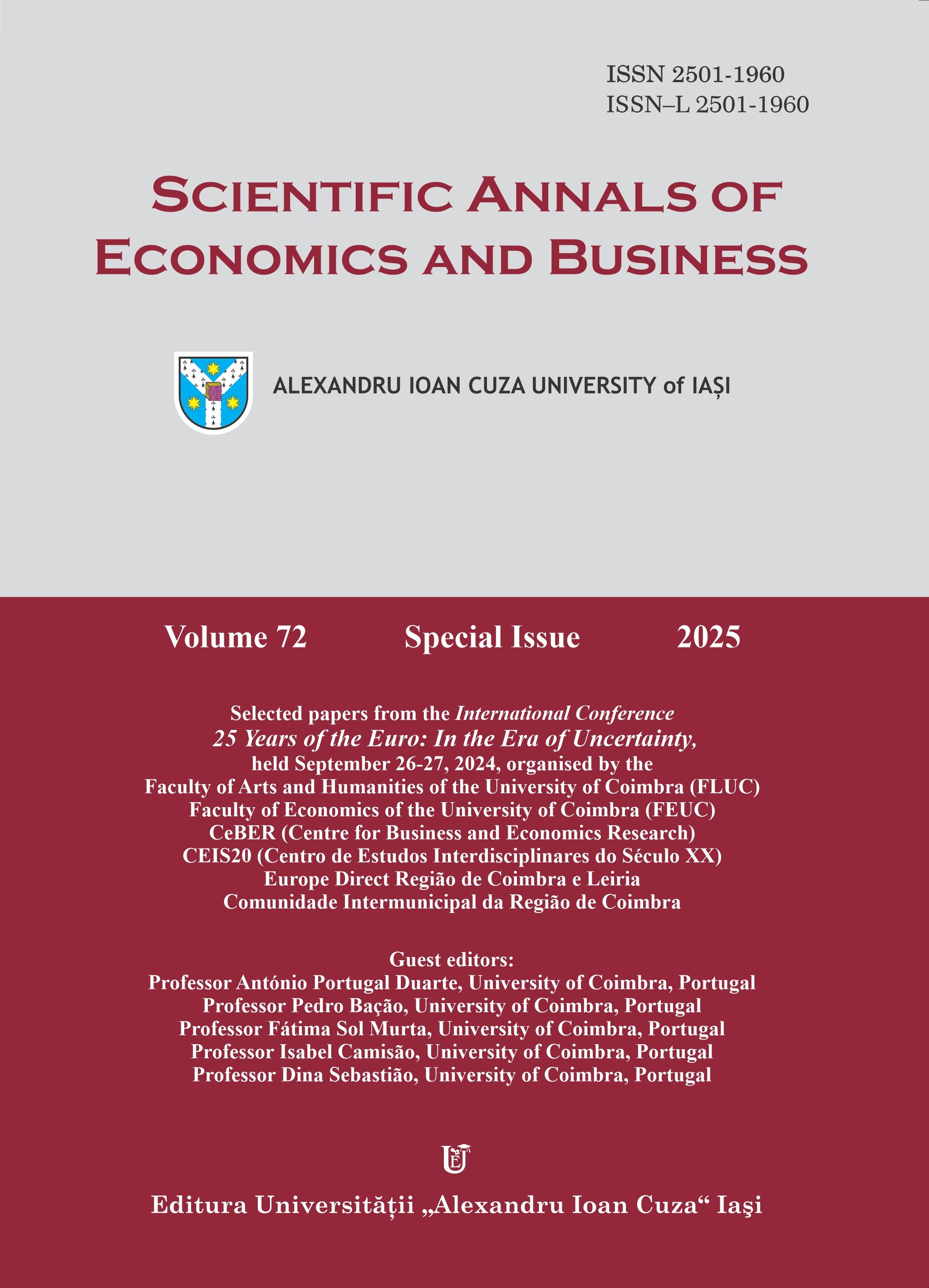
On 26-27 September 2024, the Faculty of Economics (FEUC) and the Faculty of Arts and Humanities (FLUC) of the University of Coimbra, in Portugal, jointly organized the conference “25 Years of the Euro: In the Era of Uncertainty”. The event was hosted by the FLUC and was also supported by CeBER (Centre for Business and Economics Research), CEIS20 (Centro de Estudos Interdisciplinares do Século XX), Europe Direct Região de Coimbra e Leiria, and the Comunidade Intermunicipal da Região de Coimbra. It brought together academics from economics, international relations, political science and European studies, as well as policymakers, to reflect on the achievements and shortcomings of European Monetary Union (EMU) and to discuss the challenges ahead. The programme followed the model of a previous conference held in Seville in 2019 to mark the euro’s 20th anniversary (Arcos et al., 2019), with a combination of keynote addresses, thematic sessions and open discussion.
References
Arcos, M.C., Bação, P., Duarte, A. P., Palma Martos, L. (2019). Introduction to the Special Issue “20 Years of the Euro: Achievements and Challenges”. Scientific Annals of Economics and Business, 66(SI), 141–143.
Downloads
Published
Issue
Section
License
Copyright (c) 2025 Antonio Portugal Duarte, Pedro Bação, Fátima Sol Murta, Isabel Camisão, Dina Sebastião

This work is licensed under a Creative Commons Attribution-NonCommercial-NoDerivatives 4.0 International License.
All accepted papers are published on an Open Access basis.
The Open Access License is based on the Creative Commons license.
The non-commercial use of the article will be governed by the Creative Commons Attribution-NonCommercial-NoDerivatives 4.0 International License as currently displayed on https://creativecommons.org/licenses/by-nc-nd/4.0
Under the Creative Commons Attribution-NonCommercial-NoDerivatives license, the author(s) and users are free to share (copy, distribute and transmit the contribution) under the following conditions:
1. they must attribute the contribution in the manner specified by the author or licensor,
2. they may not use this contribution for commercial purposes,
3. they may not alter, transform, or build upon this work.






 This work is licenced under a